

WORK EXPERIENCE
NHS apprenticeships
You can train in the NHS while being paid for it, from level 2 to a masters. Almost nobody is told this at school.
An apprenticeship is a job with training attached. You are employed, you are paid, and part of your week is spent learning towards a recognised qualification. You do not pay for the training.
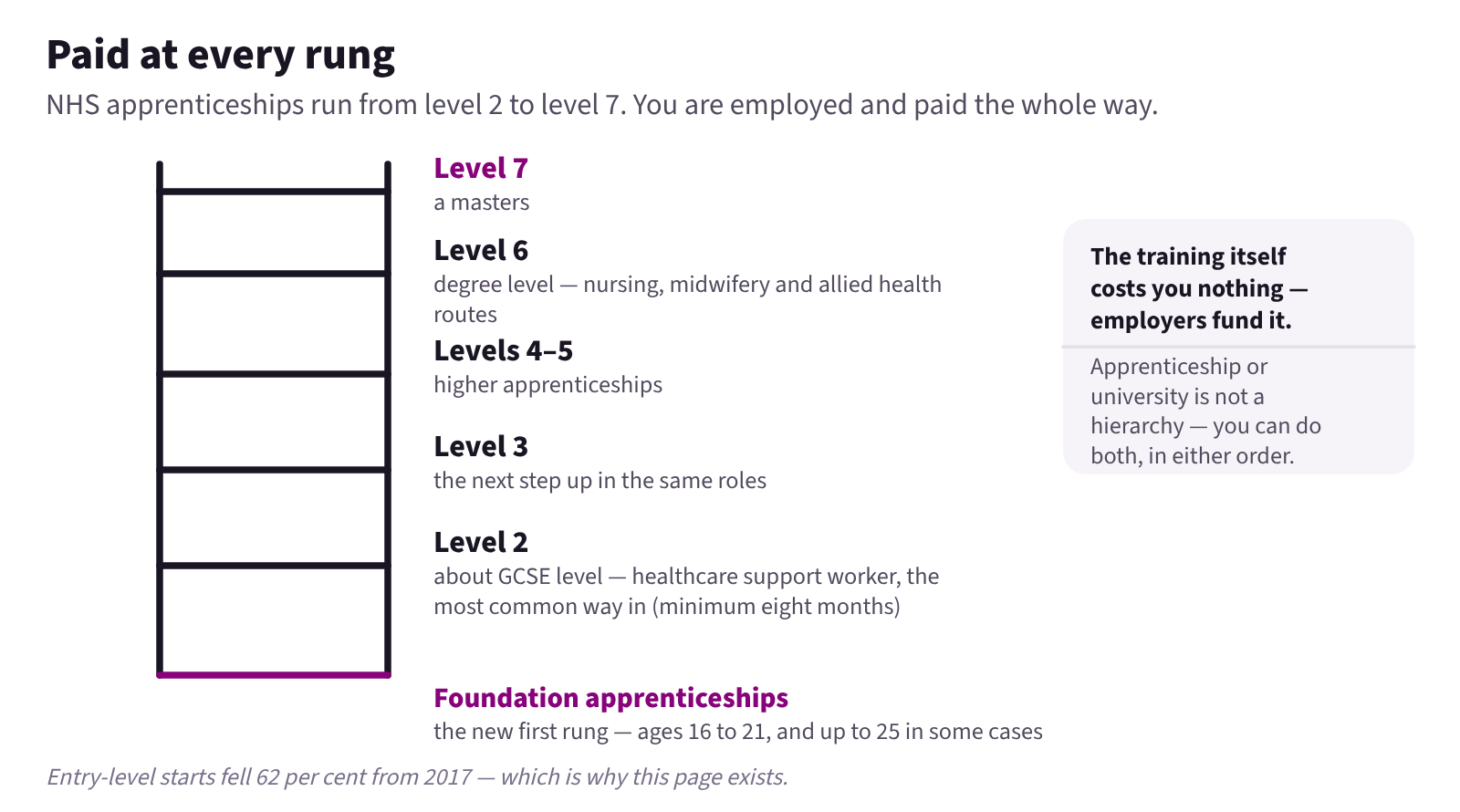
In the NHS they run from level 2, which is about GCSE level, to level 7, which is a masters. That range is the part people find surprising: an apprenticeship is not a consolation prize for people who did not get the grades, it is a route that goes all the way up.
What you can actually train as
CLINICAL. Nursing, midwifery and the allied health professions all have apprenticeship routes. Healthcare science too. A degree-level clinical apprenticeship needs more than six hours a week of off-the-job training, which tells you how substantial it is.
SUPPORT ROLES. The level 2 healthcare support worker apprenticeship runs for a minimum of eight months, and is the most common way in for somebody with no healthcare experience at all.
EVERYTHING ELSE THE NHS NEEDS. Clinical coding, finance, administration, estates and facilities. The NHS is not just doctors and nurses, and roughly half of its roles are not clinical at all.
→ Roles in the NHS — who does what
The new one, and why it exists
Foundation apprenticeships are the first of their kind in health and social care, aimed at people aged 16 to 21 — and up to 25 in some cases. They map onto roles including healthcare support worker, adult care worker, personal assistant and mental health support worker.
They exist because the bottom of the ladder has been disappearing. Intermediate apprenticeship starts in health, public services and care fell by 62 per cent between 2017/18 and 2025/26. That is not a small decline in a niche route; it is most of the entry-level training in the sector, gone in seven years.
So if somebody tells you apprenticeships are not really a thing in healthcare, they were nearly right until very recently. They are wrong now, and the timing is in your favour.

What you get paid
Apprentices must be paid at least the apprentice national minimum wage, which rises to £8.00 an hour from April 2026. Many NHS employers pay more than that, on the same pay scales as everybody else.
And if you already work for the NHS and start an apprenticeship, your basic pay is protected — you keep the higher of the apprenticeship rate or what you were already on. Nobody takes a pay cut to train.
What it costs you
The training itself, nothing. Employers fund apprenticeship training through a levy on their pay bill, which replaced the old apprenticeship levy in April 2025. You are not taking on debt for it.
What it costs is time and flexibility. You are committed to an employer for the length of the programme. Your holidays are a job’s holidays, not a student’s. And the training is specific to the role, which is the point and also the limitation — changing direction later is harder than it would be from a general degree.
Apprenticeship or university
There is no general answer and anybody who gives you one is selling something.
What is true is that the two are not a hierarchy. You can do an apprenticeship and go to university afterwards, or the other way round — though the funding does not always work in that direction. A degree gives you breadth and three years to work out what you want. An apprenticeship gives you a wage, a job at the end, and experience that employers can see rather than infer.
What should not decide it is what anybody else thinks it looks like. That includes your school, which is measured on where its leavers go, and it includes your parents, who may have been told the same thing you were.


Where to look
Start with the trusts nearest you — every one advertises its own apprenticeships — and with the national NHS jobs listings. Ask what level the apprenticeship is, how long it runs, what qualification it ends in, and what happens at the end of it.
That last question is the one worth pressing. An apprenticeship that leads to a job and one that merely ends are very different things, and the answer varies by employer.